Watermelons, redwoods, wild fantasies

A few weeks ago, I met with this team to discuss an upcoming exhibition. In one hand, I lugged five oil paintings, each one carefully wrapped in fabric. In the other hand, I dragged a bag teeming with the contents of my weekly CSA box, which included a whole watermelon. This is the ideal story of my life: juggling art and food.

I have never had passionate, soul-feeding, creative time that did not involve art or food. I love cooking for dinner parties as much as I enjoy slathering gesso on canvas. (Grocery shopping and stretching canvases, however, are not preparative tasks I like.)

In my wildest fantasies, I'd merge art and food in a creative co-op, nestled somewhere in the coastal redwoods. There would be cabins, wherein each artist would create. Each artist would be financially responsible for his/her cabin, including mortgages/rents, taxes, maintenance, and utilities. We would grow food, keep chickens and bees. Every evening, we'd assemble for dinner, with rotating chef duties for the main course, side, and dessert. Every month, we'd have "open cabins" for sharing and critiques. I can only imagine the wild creativity I would enjoy there, and the long trail runs to clear my mind.

(Some day, my prince will come ...)

Ode to October

I'm on the right.
I am smitten with autumn. It can do no wrong by me. (Even in 1997, when it ripped my heart out and shattered it into infinitely smaller and smaller pieces ...) I love its warm days and cool nights. I love its crisp air that holds the scent of drying leaves. I love that it brings night, my always-welcome guest, around a little earlier each day. Perhaps I love it because it anticipates winter's hibernation, when my solitary self can hide without guilt.

To me, the fall marks new beginnings. This might be a legacy feeling from school years, now sadly long gone. As a kid, it was the only time of year when we got to buy anything with impunity. We got a gross of #2 pencils, probably 50+ packets of notebook filler paper (college-ruled for the older kids, wide-ruled for me and the younger kids), new colored markers, fresh glue sticks ... 

New beginnings also mean change, however subtle. With these comes reflection. I don't tend to reflect on the passage of time with traditional markers, such as calendar years or birthdays. Autumn is my time for reflecting.

What does this fall hold for me? I'm not sure. I feel like I'm in a period of change and exploration. While most autumns have been really invigorating and special, this one is so in a different way. I am more quiet. I haven't made plans, set goals. I haven't seen many friends. I am reveling in whatever each day brings, even if those days implode. I feel grateful for this time.

Creative imperatives

Industrious creator.
My studio is bright and sunny today. The clock reads 6:45AM. This is an ungodly hour for me. I might be up before 7AM if I am jet-lagged or, conversely, have a plane to catch. Today is an exception. The fog has already burned off. I'll have 4 more hours of morning sunlight in my space compared to yesterday.

I am eager to get started. I slip out of bed and pull on my painting grubbies. The floorboard creaks when I reach the bedroom door, which awakens my beau. He groans as he realizes how early I'm leaving to paint. We've been together long enough that he knows there will be far more leisurely Sunday mornings in bed than this particular Sunday, when I'm pulled—compelled—by my creative imperative.

On my desk is a book whose subtitle reads, "How does the impulse to draw something begin?" I might answer this with another question: How does the urgency to create something continue?

Restocking

I guess I should get back to food, the original reason I started writing this blog. Cooking has been waylaid by painting.

When I am creating—really enmeshed in the process—food is the last thing on my mind. I know it's cliché. I start my studio mornings with strong coffee, then move on to water and herbal teas. I'm not the neatest painter, so I end up with oils all over my hands, often on my face if I happen to brush a stray hair away. These paint-soiled hands should be nowhere near anything that goes into my mouth. If I stop to eat, I have to scrub down my hands several times to remove all traces of lead and other heavy metals. More importantly, eating means interrupting whatever flow I might be riding. It doesn't seem worth all the trouble.

I know. This is coming from someone who thinks about her meals days in advance. Someone who started a food blog.

A few weeks ago, in the middle of a creative spurt, I discovered that I had no fruits or vegetables in the house. ZERO PRODUCE. For me, this is a state of emergency. There was also no hummus, no bread, no cheese. The refrigerator was pretty bare. In the cupboards, I found crackers, dark chocolate, peanuts and almonds. I felt like a bachelor (sorry, boys.) Actually, I felt like I had failed on basic functions of daily living.

So, this preamble is to introduce a food-related post. I made homemade pasta for some friends and to carbo-load before a half-marathon. (Is carbo-loading before endurance exercise obsolete?) I cranked the dough through my pasta machine to make sheets for folded-over lasagnas. The filling was simple: herbed ricotta, sauteed spinach studded with pine nuts and raisins. A simple marinara was laid down on bottom and spooned over the top. Finally, fat rounds of fresh mozzarella finished the dish.

It felt good to be feeding myself, in a real way, again.

Laughable loves

I am in love with my studio. I feel like it is a sacred space where I can create and express with total freedom, where I can work through challenges and anxieties, where vulnerability is welcome, where I can sit for hours in sunlight and let thoughts flit in and out.

I have a lot of work to do here today. I have four canvases in progress and only a few hours before I need to be elsewhere. Instead, I am sitting on the floor, leaned against the door frame and scribbling away in my journal. I look up at the painting currently on my easel. It is almost finished. I am writing as procrastination, to avoid what might be the longest process for any creative piece: editing. I need to really look at what's there, decide what is critical and what is superfluous.

For me, editing a painting is very different from editing text, which is what I do full-time. For a painting, I have less regard for the artist's voice and more reverence for the work itself. Often, my favorite brushstrokes get painted over, sacrificed for the work as a whole. When editing a painting, I place one mark; the composition reorganizes itself around this newcomer. Does this mark matter? This process continues over and over again until the work comes together. I usually know the precise moment when a painting is finished.

Writing about painting makes me want to paint, much like reading about running makes me want to run or watching cooking shows makes me want to eat. Painting makes me want to make love.

Look, see

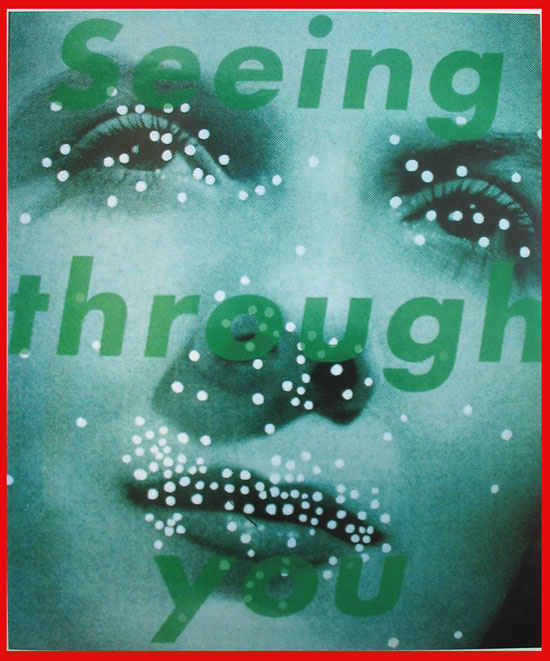
One of the reasons I love to travel is that being away gives me perspective. Not just distance from my problems and trivial woes, but literal, visual perspective. When I am somewhere else, I take the time to look, to see as much as I can. I take in the lines; note color (hue, vibrancy, tone); watch shadows to feel the textures. For a visual artist, this practice is critical.

After returning from my trips, I make a conscious effort to keep this practice alive, to maintain my "vacation eyes." On my commute to work, I try to appreciate the different scrollwork on building gates. I try to see random graffiti markings (not murals) as if they are gilt-framed paintings. I try to imagine the stories of delivery men rolling their dollies to and from their double-parked trucks. I look up and back, not just down and ahead. Inevitably, I fall back into my regular routines and I stop looking. How does one see things that are familiar with fresh eyes? Does it take rewiring? (An ex-boyfriend does research on synaptic plasticity and neural circuits of the visual cortex; perhaps he would have something to say about this, and how it might relate to our consciousness.)
Barbara Kruger, Untitled. (2004)
Looking is clearly invaluable to an artist, but it makes me wonder what kind of human being I would be if I kept my sights fresh and new. Would it make me more compassionate to my annoying coworker? Would it allow me to fall in love, in a new way, every day, with my partner? Would I be invigorated by all the discoveries that lay waiting for me, instead of being jaded by the inevitable fallibility of human nature?

Trickles ...

I am sitting in Peter's dining room. The windows are open, and bright sunlight streams in on me as I write. It is the light of summer dusk—golden. The wind blows quietly over the potted nasturtiums on the back patio. When it blows stronger, I become distracted, as if a visitor has just appeared at the back door to ask for some sugar. I am taking my time today, pausing and listening, writing a few words, pausing and listening again.

The light wanes now, dipping behind the building as the sun sets. I miss you; I have always missed you.

There is a sadness in my heart that cannot be assuaged by the laughter of friends, the comfort of family, the glow from a long, hard run. It is there when I smile at strangers, when I walk the canals of Paris or Amsterdam—and presumably Venice as well, although I have never been there. Perhaps this sadness arises from the realization that life is cruel and heartless and arbitrary. That people murder each other for cars. That my art might arise from this, as a way to understand or document or counteract or deny.

The sun has now hidden behind the clouds, somewhere on the horizon below the building. The gold has shifted to steel, and I am writing (literally, blue ink on buff paper) in gray light. Soon, I'll draw the heavy damask curtains and turn on the internal lights. Shut out any curious eyes as I burn the artificial light.

It is starting to rain again.

My love is blistering red


“There is love, he [Degas] once said, and there is a life’s work and one only has one heart.” 
-John Berger-


Tree adornment, photographed in Amsterdam, August 2012.

Alone together*


I spend a lot of time alone, by choice.

In my 9-to-5ish day, I deal primarily with text and graphics. When I leave that space, I exercise—alone—as a transition between my work life and home life.

At home, I read or write or paint. Again, all endeavors in solitude.

Even with this schedule, I yearn for more alone time. Perhaps at the beginning of one's life, the Fates dole out a quota for constant human interaction, like lucky escapes. If this is so, I exhausted my quota in the first 18 years of my life, living with 11 members of my immediate family.

Did I become a painter because I needed to fulfill this yearning for a solitary life? No matter, it's what I am. Indeed, the life of a painter is a lonely one. In one of my favorite passages by John Berger, he writes (about capturing a previously unseen image), "The result is unsettling: there is more solitude, more pain, more dereliction."

I am alone together with my work. It is a rich, engaging, aggravating dialogue to have, with myself and not-myself. At some point, the work becomes its own. Galatea speaks. If I'm receptive, I'll hear what she has to say.

*in homage to one of the most sultry songs interpreted by Chet Baker (shown above.)

Gingko timepiece

In the absence of icy snow and oppressive heat, I have had to rely on more subtle signs to discern the changing seasons. When I lose my sense of time, I use a single gingko tree I pass every morning on my way to work as a nudge. For most of the spring, it is light green, like chartreuse. In the summer, the green deepens. In the fall, the leaves fade to yellow and slowly brighten to a blazing citrus. Each fan then drops slowly, slowly ... littering the ground with tiny flames, twinkles of brightness ... until the tree becomes bare to announce that winter has arrived.

I have turned many years using this gingko-tree calendar.

Photo courtesy of Kew Gardens, England.